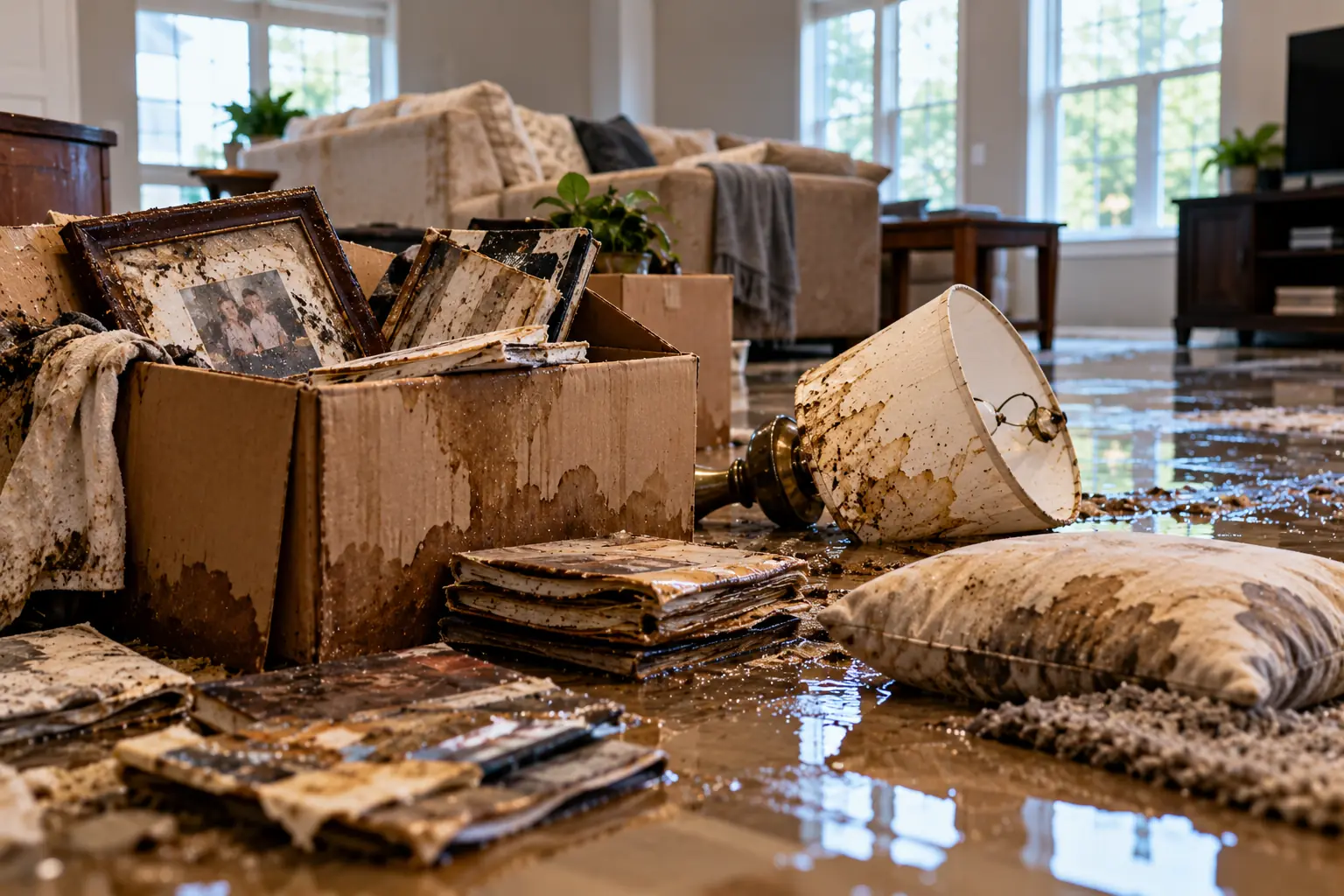
Check for hazards before anything else
Water changes how a room behaves. Before you think about the water, think about where you would be standing.
Stay out, and keep others out, if
- water is touching or close to outlets, cords, appliances, a light fitting or the electrical panel, or you cannot tell;
- a ceiling is bulging, sagging or dripping steadily, since water may be pooled above it;
- floors feel soft or uneven, or walls look bowed;
- the water may be contaminated (see below).
Water and electricity together are a serious risk in a wet room. Do not touch electrical equipment that is wet or while you are standing in water, and do not wade through standing water to reach a switch, plug or panel. If the panel is somewhere you would have to cross a wet floor to reach, leave it alone. FEMA's flood guidance on Ready.gov gives the same warning about wet electrical equipment.
There is no single rule for every house. Whether it is safe to switch something off depends on where you are standing and what is wet, so switching off is not automatically the safe choice. When in doubt, stay out. If anyone is hurt or in danger, call 911 first.
Wet tile and other hard flooring are slick. Move slowly, and keep children out of the room until it is sorted out.
Stopping the water: when it helps and when to leave it
Stopping a source limits how much more gets in, but only when the source is clear and within safe reach. Plenty of water events have no valve to turn. A sink, toilet or appliance often has its own supply valve close by, while a burst line may be controlled only at the main shutoff. If you know where the right valve is, can reach it on dry footing and nothing electrical is nearby, closing it is a reasonable first move. If any of that is missing, leave it.
Fixing a pipe, replacing a hose or working on a water heater is plumbing work, not a first step. If someone else manages the building, the shutoff may be theirs to operate, so tell them early.
| What you find | A reasonable first move |
|---|---|
| A leak at a sink, toilet or appliance line | Close the valve for that sink, toilet or appliance if it is within easy, dry reach. If it will not close or you cannot find it, step back and look at the main shutoff only if you can get there safely. |
| A leaking water heater | Keep clear. The unit is connected to power or gas and to water, so only touch its valves if you know exactly what you are doing and the floor around it is dry. |
| A stain, bulge or drip from a ceiling | The source is above and usually cannot be reached from the room. Stay out from under it and leave the ceiling itself alone. |
| Rain or storm water coming in | There is nothing to shut off. Do not climb onto a roof to look for the entry point. How monsoon storms get water into Arizona homes covers the usual patterns. |
| A backup from a drain, toilet or sewer line | Treat it as contaminated: stay out and keep children and pets out. See the section on contaminated water below. |
| Water with no obvious source | Do not open walls or floors to hunt for it. Describe where it appears and let someone with the right tools trace it. |
Moving things out of the way
Moving belongings off wet floors can save them, but only from places you can reach without stepping into water near electrical equipment or into water that may be contaminated.
Reasonable to move
- Books, papers, rugs, framed pictures and keepsakes sitting on a wet floor.
- Light furniture you can lift or slide without strain, especially upholstered pieces and anything with wooden legs.
- Clothes, bedding and boxes from low shelves and the floor of a closet.
Better left where it is
- Large appliances and heavy furniture, since awkward lifting in a wet room is how people get hurt.
- Anything standing in or beside possibly contaminated water.
- Anything directly under a sagging or dripping ceiling.
- Plugged-in electronics sitting in or beside water.
What to leave alone for now
Some well-meant actions make a wet room more dangerous or complicate what comes next.
- An ordinary household vacuum. Most are not built for wet pickup and can become an electrical hazard.
- Equipment near wet outlets. Unplugging something is reasonable only when the outlet and the floor around it are dry. Otherwise, leave it.
- A bulging ceiling. Do not poke or cut it to let the water out. What is above it can come down all at once.
- Wet carpet, drywall and baseboards. Pulling them out can expose wet insulation, wiring or sharp edges, and wet material is heavy. It can wait until someone has looked at the area.
- Drying equipment you have not used before. Used badly it adds electrical and trip hazards, and nothing it does replaces knowing how wet the materials still are.
When the water may be contaminated
Clean water from a supply line is the easiest situation to reason about. Other sources change the picture. Water pushed back up through a drain or toilet and water that entered from outside can both carry contamination, and that changes what is safe for you to touch. CDC's floodwater safety guidance notes that floodwater may contain sewage and that staying out of it is the best protection.
For a sewer or drain backup the guidance is short: stay out, keep children and pets out and do not try to clean it up yourself. A plumber can look at why it backed up, which is a separate matter from the water already on the floor. If you have touched it, wash the area with soap and clean water as soon as you can.
Most household leaks start as clean water, but the source is not always obvious. When you are unsure, treat the water as possibly contaminated until someone tells you otherwise.
Why a dry surface can mislead
When the visible water is gone, the job is not necessarily finished. Surfaces dry first, and what lies under and behind them dries last. A floor can feel dry underfoot while the pad and subfloor beneath it stay damp, and a wall can look normal while its lower section and the cavity behind it are still wet.
That retained moisture causes the later problems: swelling and warping, stains that appear or spread, peeling paint, a damp or musty smell and other moisture-related damage that tends to get worse the longer materials stay wet.
Touch is a poor test
Nobody can tell by feel when a material is dry, and a calendar is no better. Measurement is what settles it: EPA's flood cleanup guidance says a moisture meter can help show whether walls, cabinets and flooring are dry. That is one reason a wet area that seems fine is worth a phone call.
Not sure a wet area is really dry? Call and say what you saw.
Call (480) 591-9654How materials hold water
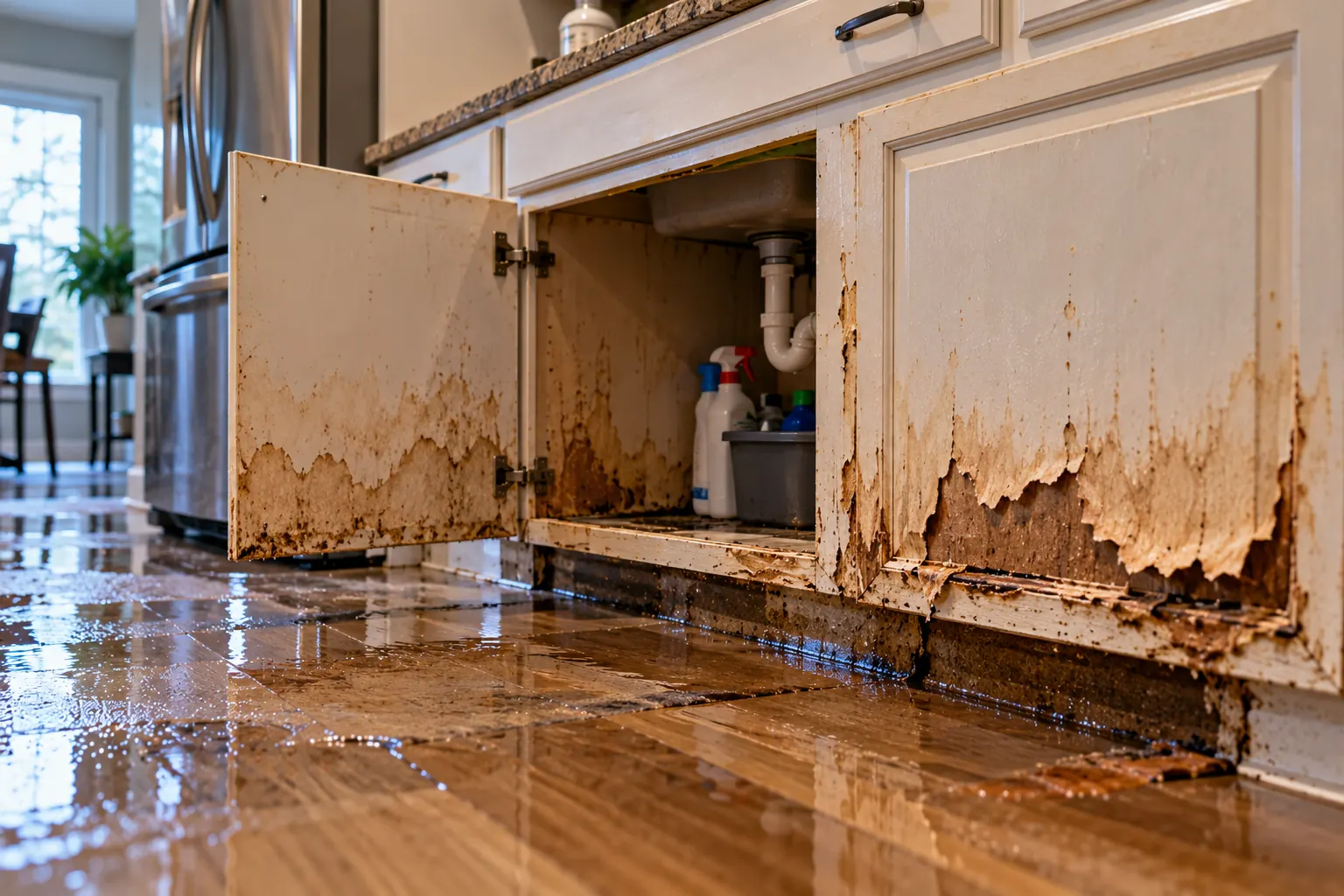
The same water behaves differently depending on what it lands on. EPA's flood cleanup guidance sorts materials mainly by how much water they soak up, and the entries below follow the same idea. None of them is a rule about what can be saved, which varies with the material, the time it spent wet and the kind of water.
| Material | What to know |
|---|---|
| Sealed hard surfaces, such as tile and sealed concrete | Water does not soak in, so the surface shows little. The trouble can be at seams, grout lines and the gap by the baseboard, where water travels to the subfloor or wall beside it. |
| Carpet and pad | The fibers can dry on top while the cushion below stays saturated, and the pad often holds more water than the carpet above it. Whether carpet can be dried in place depends on the time and the source. Contaminated water is a different situation altogether. |
| Drywall | It can draw water upward from the bottom and stay damp inside after the paint looks fine. Areas that are soft, swollen, crumbling or discolored suggest it has taken on a lot of water. |
| Ceilings | Water collects above a ceiling and finds its way out at the weakest point, so a stain can sit well away from the leak. A wet ceiling is heavy, so stay out from under any part that is bulging. |
| Insulation | Inside walls and above ceilings it can hold water out of sight and stay wet longer than the surface does. It is a reason not to assume a wall is fine because it looks fine. |
| Wood and laminate flooring | Boards and planks can expand and distort as they take on water, and moisture trapped under the surface layer may stay there unseen. Warping can show up after the water itself has gone. |
| Cabinets and baseboards | They sit right where water lands, and many are made of particleboard or similar composites that can swell and soften when wet. Water can also slip behind them into the wall. |
When it makes sense to call
A small amount of clean water that you wiped up quickly, in a spot where you can see where all of it went, may be nothing more than a cleanup you handle yourself. The line is whether you can honestly say where all the water went.
Calling for help makes sense when:
- you cannot find or stop the source;
- water has reached walls, ceilings or insulation, or a ceiling is stained, sagging or bulging;
- more than one room, or a large area of flooring, is wet, or carpet is soaked through;
- the water came from a backup or from outside, or may be contaminated;
- the water sat for a while before you noticed it;
- you are unsure whether the electrical setup in the area is safe;
- an area that dried on the surface still smells damp, or stains keep returning.
What helps on a call
You do not need all of this, and "I don't know" is a useful answer.
- Where the water came from. And whether you were able to stop it.
- What kind of water it was. From a pipe, from rain, from a drain or toilet, or unknown.
- Which rooms are wet, and what is in them. Carpet, wood, tile, drywall, a ceiling.
- How long the water has been there. A best guess is fine.
- Hazards you noticed. Water near outlets, a sagging ceiling, an odd smell.
- Who is still in the home and which rooms are in use.
For an outline of what professional water damage restoration in Tempe usually involves, see the main page. Steps differ by property: a business or multi-unit building adds questions about access and shared spaces, which the commercial water damage page covers.
Ready to talk it through? Call and say where the water came from and what it reached.
Call (480) 591-9654