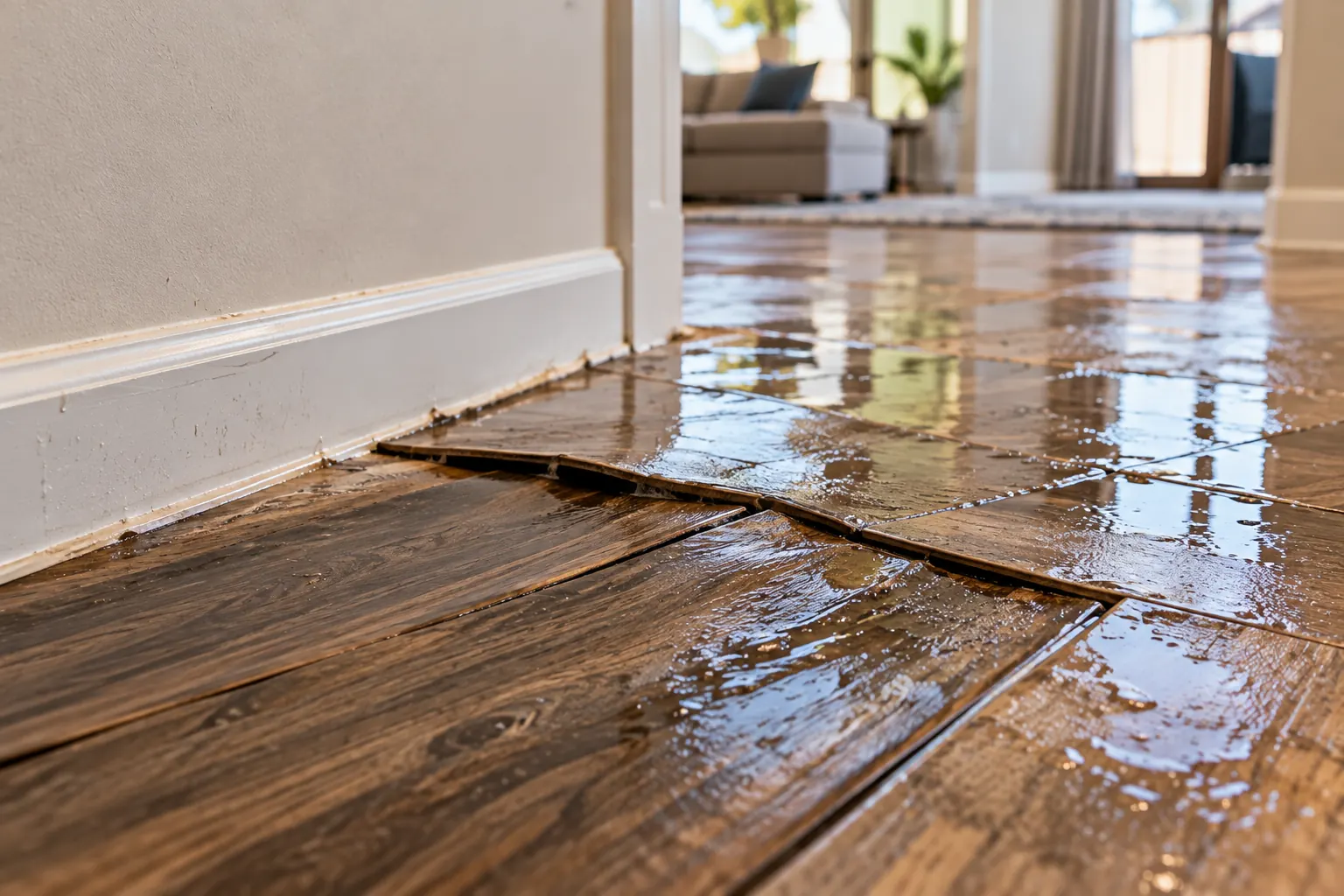
Water travels under floors, not just across them
A floor is a surface layer on top of an underlayment or adhesive, on top of a subfloor or a concrete slab. Water that finds a seam, a gap at the baseboard or an edge near a door can run beneath the surface layer and spread well beyond the visible puddle.
That is why the surface alone is a poor guide. A floor that looks undamaged may have water trapped beneath it, and a floor that looks bad may have a dry subfloor. Carpet is a different case, with its own pad to deal with, and has its own guide.
Floor by floor
The table describes how each material tends to respond. It is a guide to what to look for, not a prediction for your floor.
| Floor | How water affects it | What decides whether it stays |
|---|---|---|
| Solid hardwood | Wood swells as it takes on moisture and shrinks as it loses it. Boards can cup (edges rise), crown (centers rise), open gaps or lift off the subfloor in a buckle. | How wet it got, how long it stayed wet and whether it dries evenly. Some floors flatten as they dry and can be refinished; others stay distorted. |
| Engineered wood | A real-wood top layer over a plywood or fiberboard core. Edges can swell and the layers can separate. A glued-down floor traps water differently from one that floats. | Whether water got between the layers, and whether the core can dry without further movement. |
| Laminate | A fiberboard core under a printed surface. Water gets in at seams and edges, and the core swells and lifts the joints. The swelling often stays after the core dries. | How much the edges and seams have swollen. Water that reached only the surface can be a different story from water that got into the joints. |
| Vinyl plank and sheet | The vinyl is not harmed by water, but water goes through seams and under it, and can loosen adhesive or stay trapped below. | Whether water is trapped underneath. Click-together planks can sometimes be lifted and dried beneath; glued floors are harder. |
| Ceramic and porcelain tile | The tile and sealed grout shrug off water, but water passes through grout lines to the layers beneath. Loose or hollow-sounding tiles and cracked grout can point to a wet base. | What is under the tile: a concrete slab, or a wood subfloor and backer board that can stay wet. |
| Concrete slab | Not damaged by water, but it can hold moisture for a long time and pass it up into whatever sits on top. | Whether the slab is dry enough for new flooring. See the slab test below. |
| Wood subfloor | Plywood or boards under the finished floor. They can swell, soften and stay wet long after the surface is dry. | Whether it can be dried with the floor in place, or whether the surface layer has to come up to reach it. |
A research paper from the U.S. Forest Service's Forest Products Laboratory says that movement as moisture content changes is among the main performance characteristics of wood flooring. For a wet wood floor, that makes how it dries as important as how wet it got.
Floor wet, or not sure what is under it? Call and describe the floor.
Call (480) 591-9654Damage can show up after the water is gone
Cupping, buckling and gaps often develop over days as the wood loses moisture unevenly. A floor that looked fine on day one can look different on day five. That does not mean something was done wrong. It means the first look was early.
The reverse also happens: a floor that has distorted a little can settle once it has dried. Neither outcome can be read from a first look, and neither is a reason to hurry a repair. Sanding, refinishing or replacing boards belongs after the floor has finished drying, and that work is flooring trade work, separate from drying.
How a floor is judged dry
Touch and appearance are not enough. EPA's flood cleanup guidance says a moisture meter can help show whether materials such as walls, cabinets and flooring are dry and ready for refinishing, and warns against sealing or finishing wet materials until they are completely dry inside.
A simple slab check from EPA
EPA describes a check for a concrete slab before new flooring goes down: tape the edges of a clear plastic sheet to the slab and wait about 16 hours. If moisture shows on the plastic, the slab is still too wet. EPA notes the method is based on an ASTM standard. It is a check for a bare slab, not for a floor with finishes on it.
For how long drying runs, see what changes drying time, and for the method, structural drying.
What helps early
- Check the hazards first and remove standing water, then lift rugs, furniture and boxes off the floor so air can reach it. What to do after water damage covers the order.
- Keep the room ventilated when outdoor air is not very humid. EPA notes that humid, warm air outside slows drying.
- Leave a buckled or lifting floor alone. Nailing boards down or weighing them with furniture can interfere with drying.
- Wait on new flooring, finishes and sealers until readings say the floor and the slab are dry.
- Check where the floor meets the walls and cabinets. Water often continues into the trim and cabinet bases and the bottom of the wall.
Questions about wet floors
Will cupped hardwood go flat again?
Sometimes, once it has dried evenly, and sometimes not. The result depends on how wet the boards got and how they dried. It cannot be judged until the floor is dry.
Does tile have to be replaced after a flood or leak?
Not because of the tile itself. The question is what is beneath it. Loose or hollow-sounding tiles and cracked grout are reasons to check the base.
Can I lay new flooring over a damp slab?
EPA's guidance is to confirm the slab is dry before replacing flooring, because moisture left in it can cause problems later. The plastic-sheet check above is one way to test a bare slab.
Does laminate swell back down when it dries?
Swollen laminate edges often stay swollen, since the fiberboard core does not shrink back well. That is why laminate with swollen seams is frequently replaced, but each case differs.
Questions about a wet floor? Call and say what kind of flooring it is.
Call (480) 591-9654Sources
Checked October 4, 2026.
- U.S. EPA, Flood Cleanup to Protect Indoor Air and Your Health (moisture meters, slab check, humid outdoor air).
- U.S. Forest Service, Forest Products Laboratory, Measurement and Practical Application of Tangential Dimensional Change Coefficients to Hardwood Flooring (FPL-RP-711, 2022).