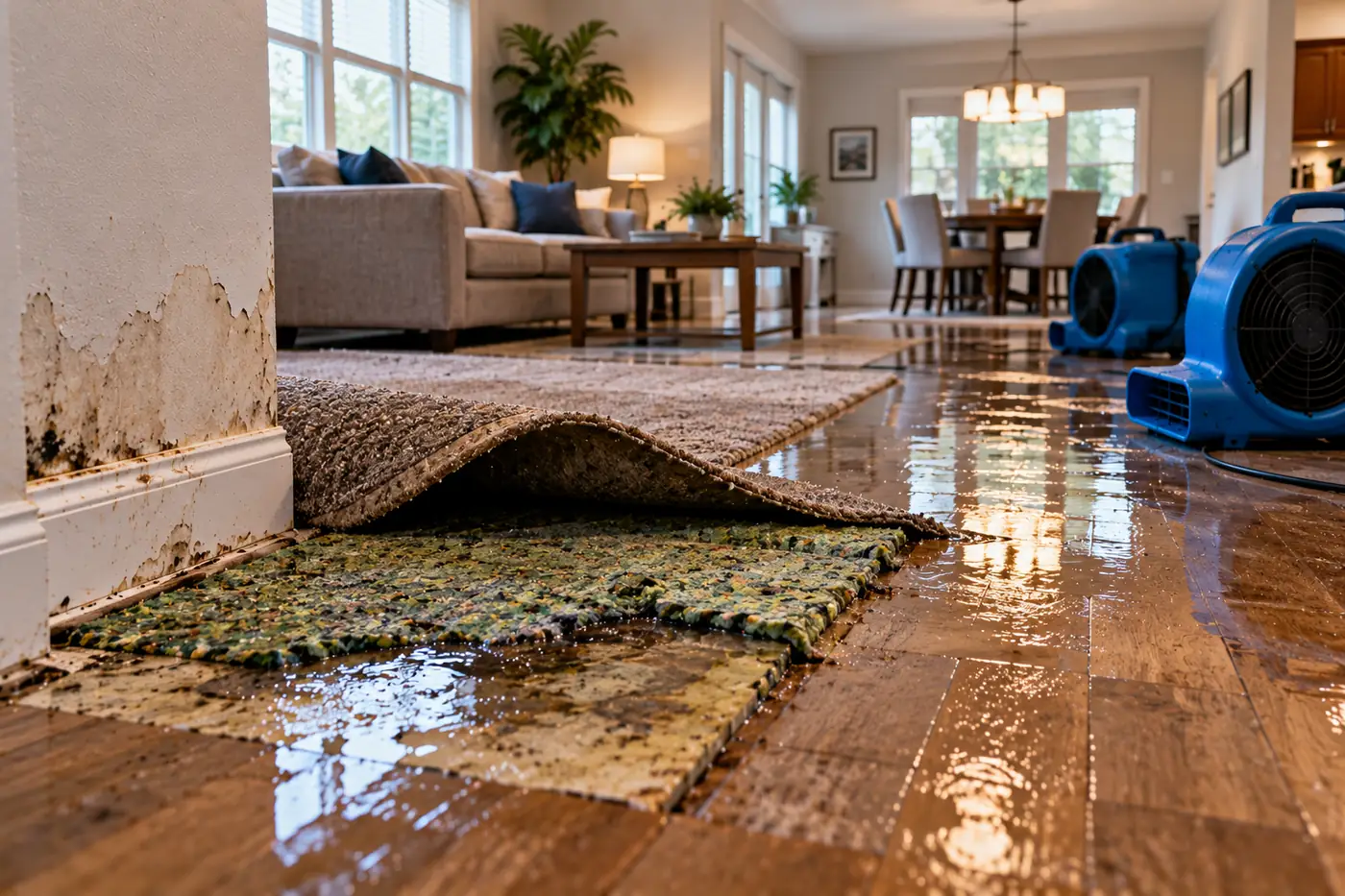
Three layers, three different answers
Your wall-to-wall carpet is a stack: fibers and backing on top, a cushion under them and a subfloor or concrete slab under that. Water soaks downward, so the layers never end up equally wet. Carpet that feels almost dry on top can sit on a pad that still holds most of the water.
| Layer | What water does to it | What that usually means |
|---|---|---|
| Carpet (fibers and backing) | Holds water but gives it up faster than the layers below. Heavy staining, a separating backing or a lasting odor show it took more than a surface wetting. | The layer you are most likely to keep, when the water was clean and drying started early. |
| Cushion (pad) | Soaks up water like a sponge and gives it up slowly, sealed between carpet and floor. | The layer most often replaced, even on jobs that keep the carpet itself. |
| Subfloor or slab | Plywood, boards or concrete. Water that gets through the pad keeps the floor wet, and a wet floor keeps rewetting the pad. | Decides when your carpet can go back down. Dry carpet over a wet floor is not a finished job. |
Because the pad and floor sit out of sight, your hand on the surface tells you little about them. EPA's flood cleanup guidance points to moisture measurement for telling whether walls, cabinets and flooring are dry. Moisture mapping beneath your carpet settles the question where your eye and hand cannot.
Why the kind of water matters most
Water from a supply line, or from a sink or tub overflow with no contaminants, starts out clean. Clean water caught early gives your carpet its best chance of drying in place.
Water from a drain or toilet backup, or runoff that came in from outside, is Category 2 or 3 water: gray or black. CDC's cleanup guidance says to throw away anything you cannot clean or dry quickly, and its examples include carpeting, carpet padding and rugs.
A Connecticut state facilities guidance document says that when water is gray or black, replacing saturated porous materials, carpet cushion among them, is typically the only recourse. The same document allows that professional cleaning can sometimes restore carpet wet with gray water, though never the cushion under it.
Clean water does not stay clean
Clean water picks up soil from your floor and turns worse as time passes. Carpet that sat wet for a long stretch after a clean source no longer belongs in the clean-water group. Category and class are the labels behind that judgment, and the guide to water categories and classes defines each one.
When you cannot name the source, treat the water as contaminated until a professional assessment says otherwise. Keep yourself, children and pets off the carpet until then.
Slab, heat and monsoon runoff
When your carpet sits on a concrete slab foundation, the stack dries differently. Water that reaches the concrete soaks into it, then keeps feeding moisture back up into your pad after the surface feels dry. Until moisture mapping shows the slab back at structural equilibrium with the dry rooms around it, new pad or reset carpet goes down onto a wet base.
- Post-tension slabs: If your home sits on a post-tension slab, steel tendons run through the concrete under high tension. Nobody should drill or cut that slab to chase moisture without locating them first.
- Dry heat: Arizona's low humidity pulls moisture off the carpet surface quickly. The fibers feel dry while the pad and slab below stay wet, so a dry-feeling carpet is not your signal to wait.
- Monsoon runoff: Storm water that reaches carpet through a door or a garage entry carries dirt and whatever it crossed outside. Where caliche or hard desert soil sits near the surface, rain soaks in slowly, so runoff pools at slab edges and low entries and wicks under the carpet from the wall line.
- Air conditioning: A closed, cooled house slows evaporation from a carpet that sits on a wet slab. Controlled drying sets the airflow and moisture removal to the materials, not to the room temperature.
Drying in place or removal
Neither is the default. The decision comes from the type of water, how long your carpet stayed wet, what moisture mapping finds in the pad and floor, and the condition of the backing.
What drying in place involves
Controlled drying loosens the carpet at an edge, dries or replaces the pad and moves air beneath the carpet until the floor reads dry. The slab and the walls get the same measured approach through structural drying. Once lifted, carpet needs re-stretching and re-securing, so drying in place still disrupts your room for a while.
What leans toward removal
- The water was contaminated, or nobody knows its source.
- The pad holds water across a large area, or your carpet has sat wet for a long stretch.
- The backing separates from the fibers, or the carpet ripples and will not lie flat.
- A musty odor returns after the carpet seemed dry.
- Drying cannot reach the floor underneath while the carpet stays down.
Removal does not have to mean the whole room: replacing the pad and keeping the carpet, or replacing one wet section, both work depending on the carpet and the layout. If carpet and pad stay wet, mold can grow in them, and EPA's guidance says porous materials such as carpet may have to go if that happens. That is why an honest evaluation reads the pad and the slab, not just the surface you walk on.
While the carpet is wet
Carpet squishing underfoot, or unsure what kind of water soaked it? Call for moisture mapping.
Call (480) 591-9654Close the main water shutoff
If a supply line or fixture still feeds water onto your carpet, close the main shutoff. New water on top of old keeps the whole stack wet and pushes moisture deeper into the slab.
Switch off the breaker from a dry spot
Wet carpet near outlets, cords or appliances is an electrical hazard. Switch off the breaker for that room only if you can reach the panel from dry ground, and stay out of the room if you cannot. What to do after water damage sets the order of these first steps.
Stay off contaminated carpet
If the water came from a drain, a toilet or outside, keep yourself, children and pets off the carpet entirely. Every step on a soaked pad presses water deeper into it and spreads whatever the water carries.
Leave the carpet down and the pad untouched. Pulling wet carpet exposes the sharp tack strips at the edges, a soaked roll weighs far more than it looks, and lifting it tells you nothing about the slab. Each hour the pad stays wet raises the odds that it, and then the carpet, has to come out.
When it makes sense to have it looked at
A small patch of clean water on carpet you can see end to end may stay a minor event. Small, clean, caught early and fully visible: anything short of all four falls past the line the guide to doing it yourself or calling for help draws. Call for a professional evaluation when:
- you do not know where the water came from, or it may have come from a drain or from outside;
- the pad squishes when you press it, or the wet area covers most of a room or more than one room;
- water has reached the baseboards or the bottom of a wall, since carpet wicks it into the drywall;
- your carpet sat wet for a while before anyone noticed;
- a smell remains after the carpet seemed to dry.
Each of these means moisture has moved somewhere you cannot read by touch. Calling promptly keeps a pad replacement from growing into a subfloor, baseboard or drywall replacement.
Questions about wet carpet
Can wet carpet dry without coming up?
Sometimes. Clean water caught early, over a floor that drying can reach, gives your carpet the best odds. Drying from the top alone leaves the pad and slab unmeasured, which is why moisture mapping under the carpet decides it.
Does the pad always need replacing?
No rule says so, but the pad is the layer most often replaced, since it holds water and gives it up slowly. Whether yours can dry depends on the water, the time and how wet it got.
Will cleaning the carpet fix a damp smell?
Not by itself. A smell that comes back usually means moisture remains in your pad or slab, and surface cleaning does not reach it.
Should I pull up wet carpet myself?
No. Lifting wet carpet exposes sharp tack strips, strains your back under a soaked roll and, if the water was contaminated, puts you in contact with it. Close the main shutoff, keep clear and let moisture mapping decide what comes up.
How long does wet carpet take to dry?
There is no standard number. The answer turns on the factors in What changes drying time, and the real test is the floor under your carpet reading dry.
Pad still wet under carpet that feels dry? Call before the moisture reaches the slab.
Call (480) 591-9654Sources
Checked October 4, 2026.
- U.S. EPA, Flood Cleanup to Protect Indoor Air and Your Health (moisture meters; humid outdoor air slowing drying).
- CDC, Guidelines for Cleaning Safely After a Disaster (items to throw away).
- State of Connecticut Department of Administrative Services, Recommended Water Damage Response Actions at DAS Leased Properties (water types and porous materials).
- U.S. EPA, A Brief Guide to Mold, Moisture and Your Home (porous materials that become moldy).