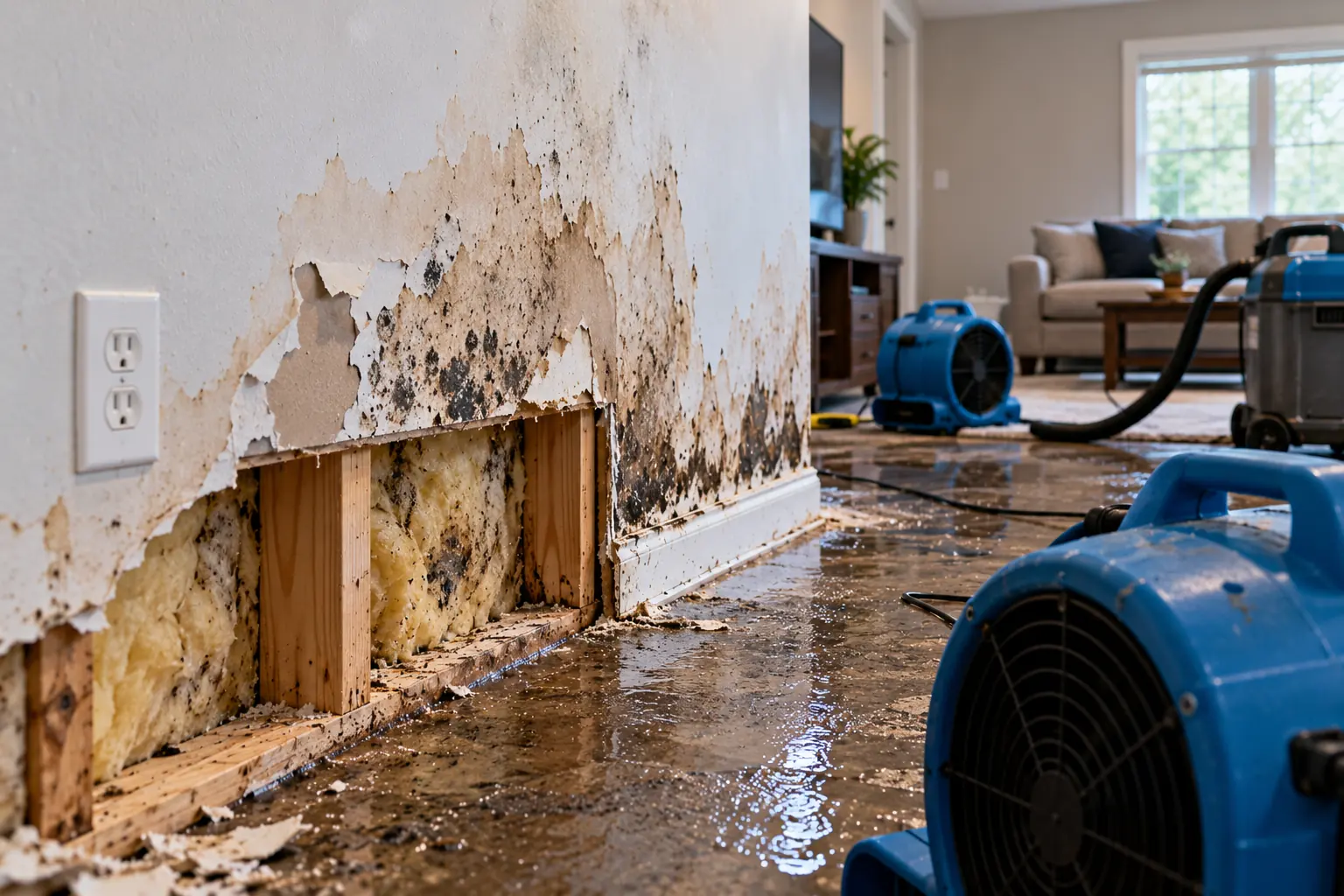
Four ways water gets into a wall
Drywall is a gypsum core wrapped in paper, and it takes up water readily. Where the water came from affects how far into the wall it went.
- From the floor up. Water standing on a floor soaks into the bottom of the wall and travels upward through the board, so the wet area can reach higher than the water ever stood.
- From above. A leak in a ceiling or an upper floor can run down inside the wall cavity and show up low in the wall, far from where it started. The ceiling guide covers that side.
- From inside the wall. Supply and drain lines, and condensate lines, run through walls. A slow leak there can wet the cavity for a long time before a stain appears.
- From outside. Rain can come through a roof edge, a window opening or the exterior wall, and wet a wall from the outside in.
What you can see, and what it can and cannot tell you
| What you notice | What it can suggest | What it cannot tell you |
|---|---|---|
| A stain or ring on the wall | Water reached that spot at some point. | Whether it is still wet, or whether the stain is old. |
| Bubbling, blistering or peeling paint | Moisture is coming through the surface, or got behind the paint. | Where the water entered, which can be elsewhere. |
| Soft, swollen or crumbling board | The board has taken on a lot of water. | How far the softness extends behind the paint. |
| A swollen or lifting baseboard | Water reached the bottom of the wall. | How high it went inside. |
| Seams that show, or nails that pop | The board has moved, which can follow wetting. | That the board is still wet, or has been. |
| A damp or musty smell | Something in the area is probably still holding moisture. | Which wall, floor or cavity it is coming from. |
Signs of damage can lag behind the water by a while, and some walls never show any. Signs of hidden water damage looks at what turns up when nothing is visibly wet.
What is behind the surface
A finished wall is a board with a cavity behind it, usually holding framing and sometimes insulation, wiring and pipes. Water that reaches the cavity can stay there, because the board on both faces slows drying.
- The cavity. EPA's flood cleanup guidance says not to seal any wall cavity that was flooded, and not to paint or seal wet surfaces, until the materials are completely dry on the inside.
- Insulation. Wet insulation can hold water out of sight. CDC's guidance says to remove and discard drywall and insulation contaminated with sewage or floodwater, and a water damage guideline from Northern Arizona University, which follows the IICRC S500 standard, treats wet wall and ceiling insulation as something to remove, not dry and reuse. That is one institution's rule, and the rest of this page is about how much else depends on the case.
- The baseboard and the board behind it. Baseboard hides the lowest part of the wall, which is where water collects. Connecticut state facilities guidance for clean-water events describes pulling baseboard back and making small openings along the bottom of the wallboard so air can reach the cavity.
- Finishes that trap moisture. Paint, wallpaper and wall coverings can hide a wet board and can slow its drying.
Dry in place, or cut out?
There is no universal rule, and nobody can make the call from a description or a surface check alone. What shapes it:
Points toward drying in place
- The water was clean and the source was stopped early.
- The board is firm, flat and not stained through.
- The cavity and insulation can be reached and dried.
- Readings show the moisture falling as the wall dries.
Points toward removing sections
- The water may have been contaminated, from a backup or from outside.
- The board is soft, crumbling, sagging or badly swollen.
- Insulation behind it is wet.
- The wall stayed wet for a long time, or stays wet despite drying.
Where sections are removed, the cut commonly goes above the line of visible damage, since moisture travels past what shows. Removing part of a wall is often a way of reaching and drying what is behind it, and replacing the board and finishing it later is carpentry and painting, a separate trade from the drying itself.
Wet wall, or not sure how far the water went? Call and describe what you see.
Call (480) 591-9654What not to assume from a dry surface
Dry to the touch is not a result
Nobody can judge the inside of a wall by feel, and a paint film that looks perfect can sit over a damp board. EPA's flood cleanup guidance says a moisture meter can help show whether walls are dry. Readings also mean more when compared with a wall that was never wet, which gives a baseline for what dry looks like in that building.
What you can reasonably do
- Stop the source if it is safe to reach, and keep clear of any wall with water near outlets or switches.
- Move furniture and belongings away from the wall so air can reach it and nothing is damaged by moisture.
- Leave cutting and drilling to someone who can check for wiring and pipes first. EPA also notes that older buildings can contain materials, lead paint among them, that are hazardous when disturbed.
- Do not paint or caulk over a wall that may still be damp.
The first-steps guide covers the safety order, and the decision guide on doing it yourself helps when the wall is the only thing wet and the question is whether to call. For how drying itself works, see structural drying.
Ready to talk it through? Call and say which wall, how far up and how long.
Call (480) 591-9654Sources
Checked October 4, 2026.
- U.S. EPA, Flood Cleanup to Protect Indoor Air and Your Health (wall cavities, moisture meters, older buildings).
- CDC, Guidelines for Cleaning Safely After a Disaster (drywall and insulation contaminated by floodwater).
- Northern Arizona University, Water Damage Restoration Guideline (insulation).
- State of Connecticut Department of Administrative Services, Recommended Water Damage Response Actions at DAS Leased Properties (baseboard and wallboard openings).