What a cabinet or trim piece is made of decides most of it
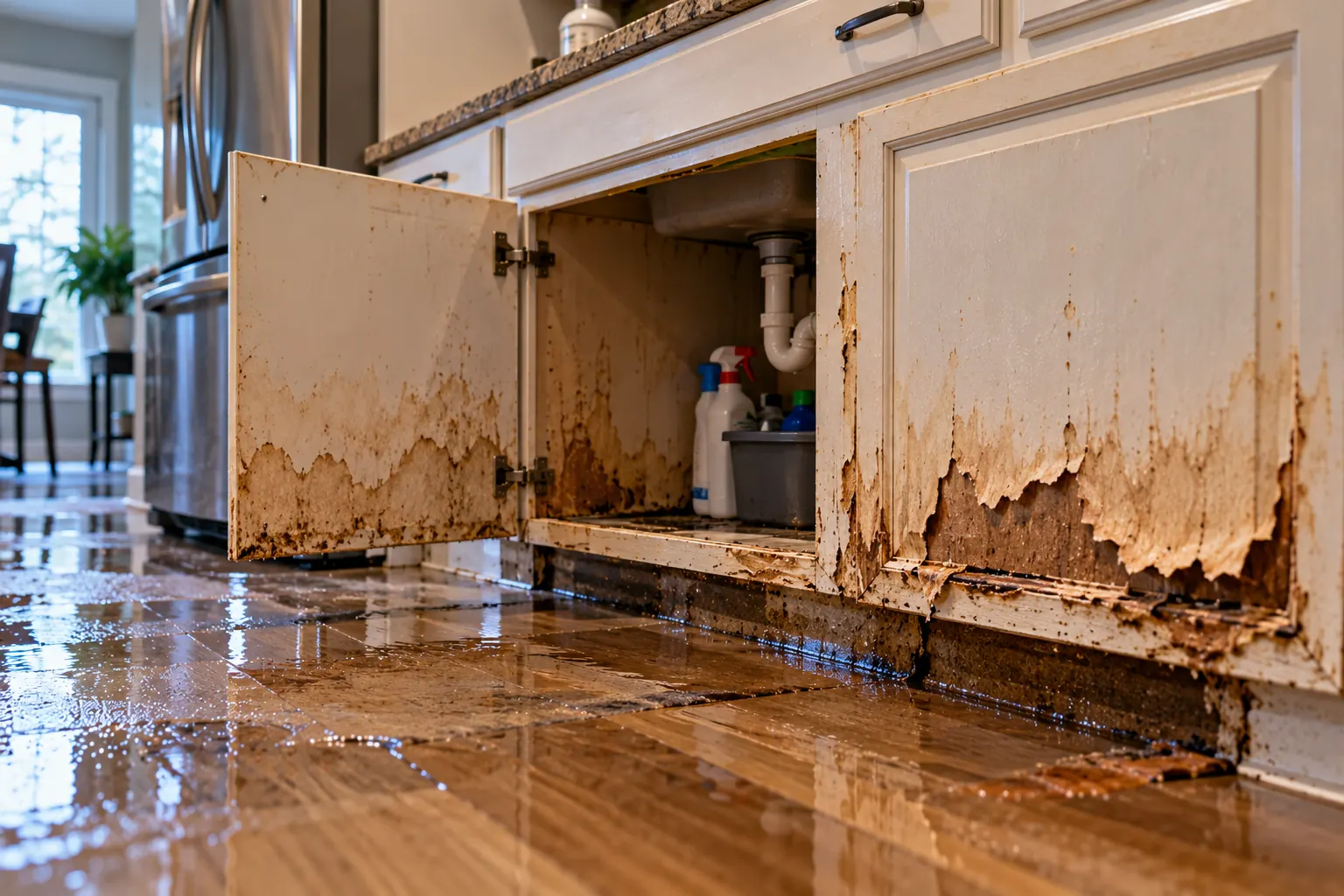
From the front, a kitchen or bathroom cabinet looks like one material. Underneath, the box, the door and the surface finish are often different things, and water treats them differently. Look at an exposed edge or the inside of a door to see what you have.
| Material | How it reacts to water | What it looks like when it has taken water |
|---|---|---|
| Solid wood | Swells and can warp, but is a single material that dries and can often be refinished or repaired. | Warped doors, a door that sticks, dark water marks, lifted finish. |
| Plywood | Layers of thin wood glued together. Tolerates a wetting better than composite board, but edges can swell and layers can separate. | Swollen edges, rippled faces, layers lifting at the bottom edge. |
| Particleboard and MDF | Wood fibers or chips held with glue. They absorb water, swell and soften, and often do not return to their original size or strength. | Puffed edges and seams, crumbling or soft corners, a bottom panel that bows, screws that pull loose. |
| Thermofoil, laminate or veneer facing | A thin surface layer glued to a core. The surface itself resists water, but moisture at the edges and the core below can break the bond. | Bubbling, peeling or lifting at corners and edges, even where the surface looks intact. |
| Painted or finished faces | Paint and finish protect the material until water gets under them. | Blistering or flaking paint, hazing, dull patches. |
None of this predicts the outcome for a specific cabinet. It does explain why two cabinets wet by the same leak can end up with different answers, and why a cabinet that looks fine can be the worse of the two.
Where the water hides
Water runs down and spreads along the lowest surfaces, so the damage is often out of view.
- The toe-kick and the floor under the cabinet. The recessed base along the floor can sit in water and wick it upward. Behind it, the floor and the bottom of the wall can be wet when the front looks fine.
- The cabinet interior. A base cabinet is a closed box. Water that reaches the bottom panel stays there, and anything stored inside can be wet along with it.
- The space behind the back panel. Supply and drain lines run through it. A slow leak can wet the back of a cabinet and the wall behind for a long time. The drywall guide covers that side.
- The gap along the wall and counter. Sealant lines between the counter, the backsplash and the wall are where water that runs down the wall finds its way behind a cabinet.
EPA's flood cleanup guidance recommends opening inside doors and cabinets and removing drawers, shelves and built-in furniture, cabinets included, so hidden surfaces can dry. It also says a moisture meter can help show whether cabinets are dry. Both apply well beyond floods: shut cabinet doors hold in moisture. Under a sink is the first place to check when a cabinet is damp with no obvious source, and a base cabinet beside a dishwasher, refrigerator or washer is the next.
Cabinets wet, with water behind them? Call and say what is affected.
Call (480) 591-9654Baseboards, casing and trim
Trim touches the floor, so it takes up water from the bottom and passes it to the wall behind. How it reacts depends on what it is made of.
- Solid wood trim can swell, but it is more likely to dry and be reused. Careful removal can protect it.
- MDF or other composite trim swells at the bottom and along cut ends, and the swelling usually stays. Painted joints open and caulk lines split.
- Door casings and jambs wick water from the floor like baseboards and can hide damage at the bottom, under paint.
- Paint and caulk can mask a wet piece. Painting or caulking over trim that may still be damp locks moisture in.
Removing baseboard is often part of drying the wall behind it. Connecticut state facilities guidance for clean-water events describes pulling baseboard back so air can reach the bottom of the wall. Once the wall is dry, the trim goes back, and whether the original pieces can be reused depends on their material and how they came off.
Countertops, doors and hardware
- Laminate counters have a particleboard core that can swell at seams and around the sink cutout. Stone and solid-surface counters are not harmed by water, but the cabinet under them can be.
- Doors and drawer fronts reveal material problems first: warping, peeling edges and sticking. Drawers that are removed and left open dry faster than closed ones.
- Hinges, slides and screws rust and loosen. Loose hardware in a swollen board often will not hold again.
Cabinets that hold dishes and food were exposed to the same water, so what was inside needs its own sorting. For contents, see water-damaged belongings.
Drying, carpentry or something else
Cabinets and trim fall between trades. Drying a wet cabinet bay and the wall behind it is one job. Replacing a swollen cabinet box, a door or a laminate countertop is carpentry or countertop work, which is a separate trade, and so is refinishing and painting.
The practical order is the same for all of it: stop the water, let everything behind and under the cabinets dry, confirm it with readings, then decide what to repair or replace. Deciding on replacement while a cabinet is still wet means judging it at its worst. The guide to mitigation, restoration and repair explains where each stage of work starts and stops.
Sources
Checked October 4, 2026.
- U.S. EPA, Flood Cleanup to Protect Indoor Air and Your Health (opening cabinets and removing drawers; moisture meters).
- State of Connecticut Department of Administrative Services, Recommended Water Damage Response Actions at DAS Leased Properties (pulling baseboard back).