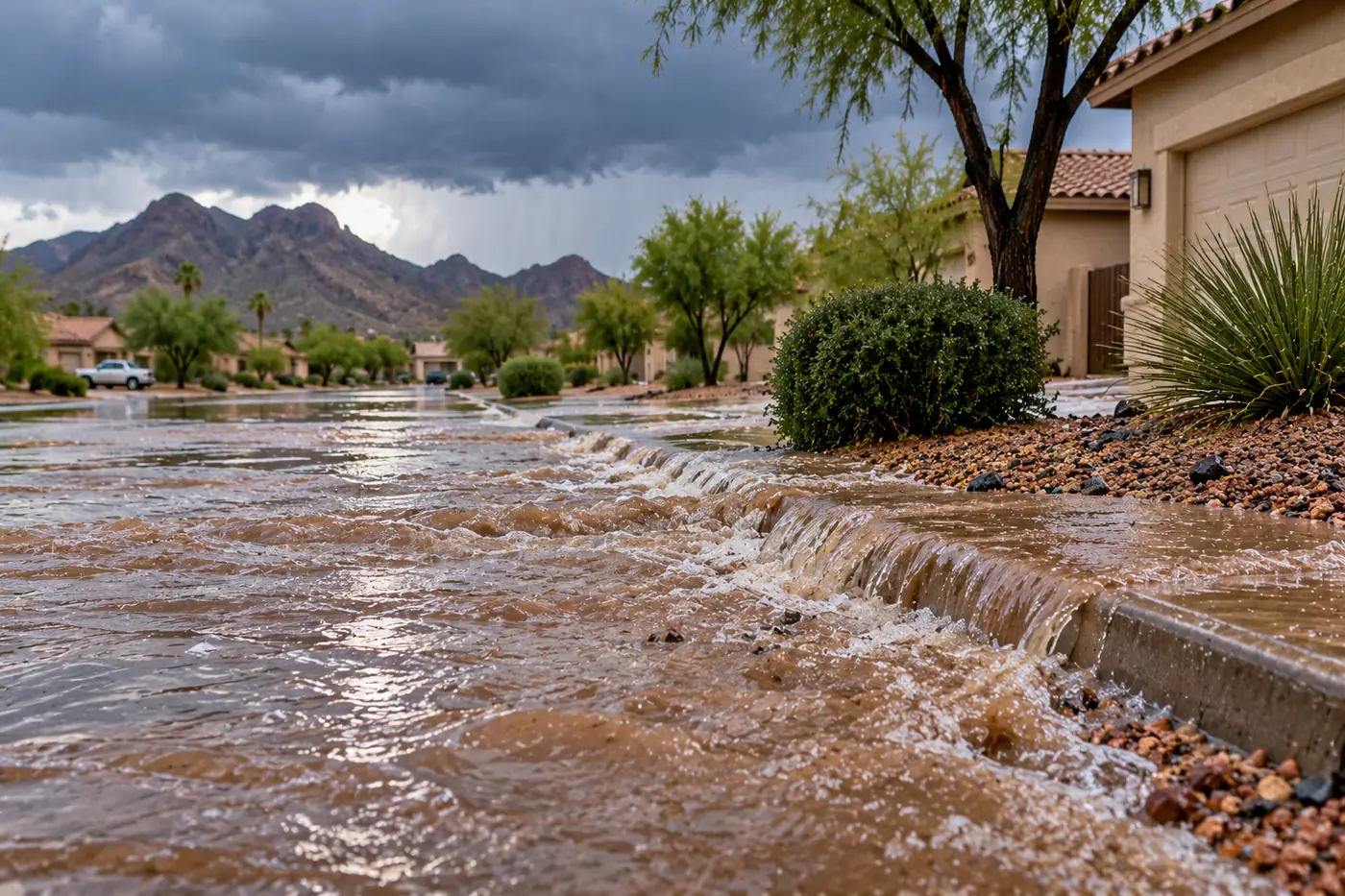
What the monsoon season is, and what it is not
The weather service's monsoon awareness page for Phoenix says the season officially extends from June 15 through September 30, the time when the associated hazards are most likely to occur. That is a calendar window. It does not predict that any given storm will damage your home, and it does not make weather outside the window harmless.
People use several storm terms as if they meant the same thing. They do not, and the difference matters when you are working out what happened to your property.
| Term | What it means, and what it means for a property |
|---|---|
| Monsoon season | The NWS window of June 15 through September 30. For your property: A period of higher storm risk, not a certainty of damage. |
| Flash flood | NWS defines it as a fast, extreme flow of high water into a normally dry area, beginning within six hours of the cause, such as intense rainfall. For your property: Water can fill streets, washes and low spots quickly, with little time between the rain and the water at your door. |
| Downburst | NWS defines it as a concentrated, severe downdraft that causes an outward burst of damaging winds at the ground. A severe one can do damage equivalent to an EF-0 or EF-1 tornado. For your property: A wind event, not a flood. Wind damage and water damage are different problems, even though one weather event can bring both. |
| Tropical remnants | What remains of a tropical cyclone after it weakens. They are not part of the monsoon. For your property: They can bring flooding outside the season: NWS Phoenix recorded flooding and severe storms from the remnants of two tropical cyclones over October 9 to 13, 2025. |
Why a low annual average does not settle anything
NWS lists Phoenix's 1991 to 2020 average annual rainfall as 7.22 inches. That is a Phoenix figure, not a Tempe measurement, and it is a total for a year. It does not tell you how much falls in one storm, or whether water will get into your building.
A single recent event shows the difference. On September 16, 2026, NWS Phoenix reported accumulations of 2 to 4 inches from northern Pinal County through northern Maricopa County, most of it within a two- to three-hour period. The runoff flooded streets, washes and creeks, and many low-lying areas and unbridged low-water crossings became impassable.
How to read these numbers
The two sets of figures come from different places and different spans of time, so they are not a direct comparison. The September report gives no Tempe totals, and one event does not make any particular Tempe property flood-prone. What the figures show is the gap between a yearly total and a few hours of rain.
How quickly the water moves
NWS explains why storm water behaves this way in a dry region. When heavy rain falls on extremely dry land, the water rushes toward low-lying areas, including dried-up channels and riverbeds, and a dry channel can quickly turn into a raging river.
For your property, the useful question is where that water goes next. Water follows the lowest ground, so a yard, driveway or entry that sits lower than the street or a nearby channel is the kind of place that tends to collect it.
- Caliche and hard soil: Where caliche or hard desert soil sits near the surface, rain soaks in slowly. More of it runs off toward your foundation, driveway and garage instead of into the yard.
- Slab foundations: Runoff that pools against a concrete slab wicks into the concrete and into the bottom plate of your walls. It keeps wetting flooring and drywall from below after the yard has drained.
- Dry heat after the storm: Arizona's low humidity dries the surfaces you can see within a short time. The slab and the wall cavity hold their water far longer, which hides how far it went.
Stay out of moving or rising water
- Maricopa County says six inches of water can knock you off your feet and two feet of water can float a car.
- NWS Phoenix says it takes only 1 to 2 feet of water to float most vehicles, including SUVs, and its message is "Turn around, don't drown."
- NWS also says barricades are there for a reason, usually because flash flooding is about to happen, is happening, or has made the road unsafe. Do not drive around one.
That applies to checking on your property too. A flooded yard, driveway or garage is not worth wading into for a look at the damage, which can wait until the water has gone.
How outside water becomes a property problem
Rain is not the only route, and each route looks different once you are standing in the house.
From above
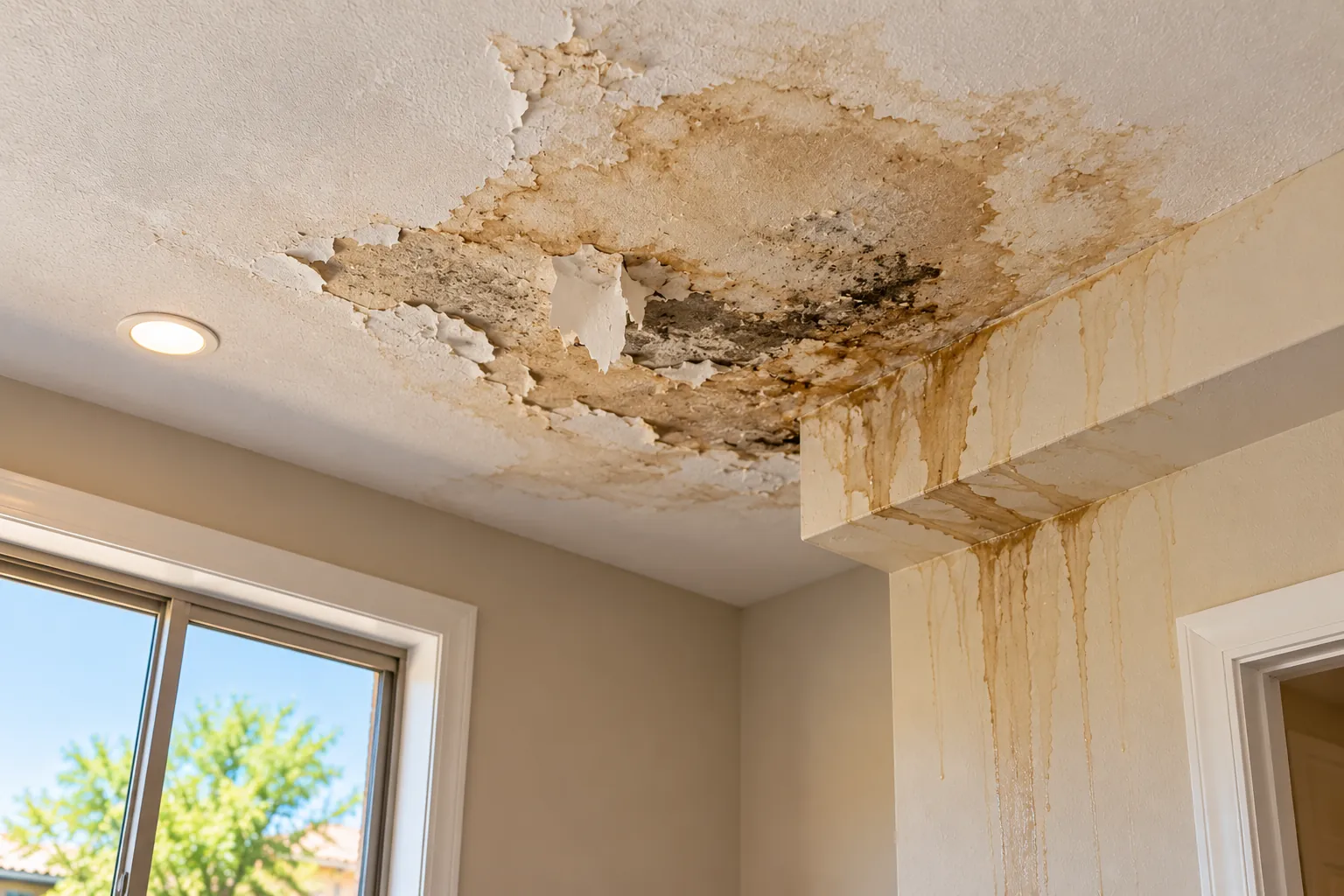
Heavy rain can find a way through a roof, and the first sign inside is usually a stain or drip in a ceiling, sometimes well away from where the water actually got in. Water above a ceiling soaks insulation and drywall and keeps spreading after the storm ends. Stay off the roof during and right after a storm, even to find the entry point.
At ground level
Runoff that reaches a property can collect at doors and in driveways, and flow into garages and other low entries. That is why Maricopa County's sandbag guidance tells people to focus on entrance areas such as front doors and low entrances. Water that comes in this way crossed streets, yards or washes first, so it may carry dirt and contamination.
Outside water that reaches carpet, baseboards or a wood subfloor counts as Category 2 or 3 until someone assesses it. While it sits, it saturates the pad, wicks up the drywall and starts loosening the layers of a plywood subfloor, so stay clear of it and keep children and pets out.
From irrigation, not rain
Not all outside water comes from the sky. Where a property receives SRP flood irrigation, water in the yard can have an irrigation cause instead of a rain cause. SRP's neighbor irrigation guidance says the fastest fix is to find where the water is coming from, which is often a neighbor who missed opening their valve or port at their scheduled time.
If that does not settle it, SRP says to contact SRP so a zanjero, one of its water-delivery workers, can turn off the delivery. SRP's pages describe this for the Valley as a whole and do not name Tempe or any other city, so this is not a statement that flood irrigation is common on Tempe streets.
Before a storm: what the official guidance covers
Official advice for your property ahead of a storm comes down to two points, both from public agencies.
- Unplug sensitive electronics. NWS Phoenix calls unplugging sensitive electronic appliances such as TVs and computers before thunderstorms the most reliable safeguard for them. That advice concerns the equipment, not keeping water out, and it belongs before the storm, on dry ground. If water already sits in a room, stay away from outlets and cords, and switch off that room's breaker only from a dry spot.
- Sandbag the entrances. Maricopa County's monsoon safety page advises filling sandbags one-half to two-thirds full, stacking them in a brick pattern and focusing on entrance areas such as front doors and low entrances. The County means that for before water reaches the entrance, not while you stand in it. Sandbags are not a promise that water will stay out.
Anything beyond this, such as roof work or changes to drainage, is outside what these sources address.
If water has already come in
If water has already entered, your safety and the source of the water come first, and water from outside deserves extra caution. Stay clear of runoff inside the house, and switch off the breaker for a wet room only from a dry spot. What to do after water damage sets out the order to work in.
Storm water that has soaked into your floors, walls or ceilings calls for extraction, moisture mapping and controlled drying: water damage restoration in Tempe. The sooner that work starts, the less of your pad, drywall and subfloor has to come out.
Monsoon cells drop rain unevenly across Tempe and the neighboring Service Areas, so a storm that floods one street can leave the next one dry. What counts is where the water reached on your own property.
Runoff under the door, or a ceiling stain after a storm? Call for moisture mapping.
Call (480) 591-9654