What you are seeing, and how pressing it is
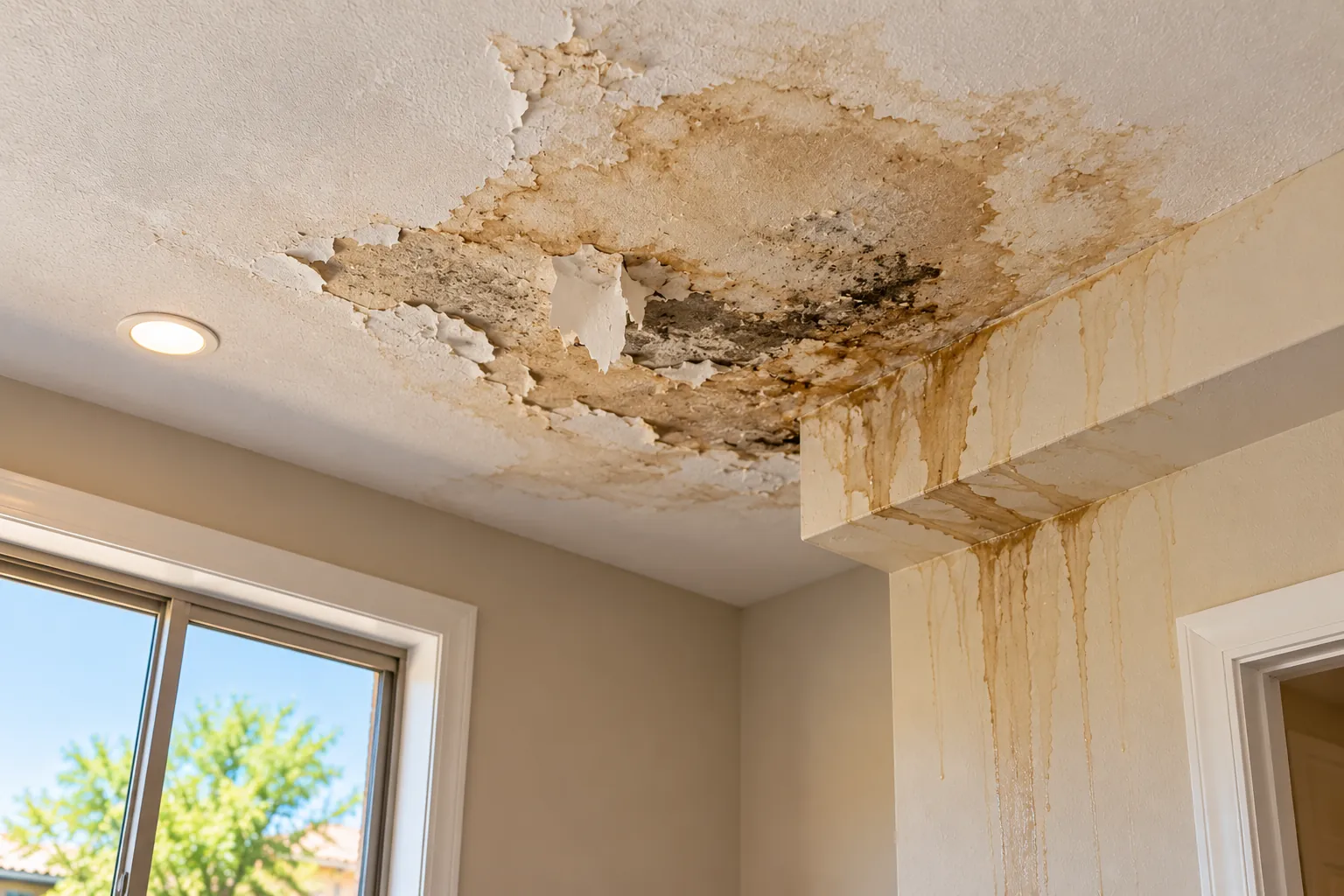
Not every ceiling mark means the same thing. The signs run from a dry old ring to water coming through right now.
| What you see | What it can mean | How to treat it |
|---|---|---|
| A brown or yellow ring that is dry | Water reached the ceiling at some point. It may be an old, finished event, or it may come and go. | Keep an eye on it. If it grows or returns, treat it as active. |
| A damp, spreading stain | Water is still arriving or the board is still wet. | Active. The source needs finding, and the area is worth describing to someone promptly. |
| Bubbling or blistering paint | Water is held behind the paint, with the board taking it up. | Treat as wet. Leave it alone. |
| Sagging, bulging or soft board | The board has taken on a lot of water, and water may be pooled above it. Wet board is heavy. | Stay out from under it and keep others out. Do not push on it. |
| Dripping | Water is passing through now. | Active. Keep clear of what is beneath it, and check for electrical hazards. |
| Water at a light, fan, vent or smoke detector | Water has found an opening in the ceiling. | Treat the fixture as unsafe to use until it has been checked. See the next section. |
The first-steps guide covers the general order of priorities, and the same cautions apply here.
Water coming through a ceiling? Call and say what you see.
Call (480) 591-9654Safety first
Water and electricity overhead
Ceilings carry light fixtures, fans, vents and wiring, and water can run along them. FEMA's guidance on Ready.gov says not to touch electrical equipment that is wet or while you are standing in water.
- Do not use a switch, fan or light that is wet or beneath dripping water.
- Whether to cut power at the panel depends on where the panel is. If you would have to cross a wet floor to reach it, leave it, and keep others away.
- When you are not sure, stay out of the room and ask an electrician. If anyone is hurt, call 911.
- Stay out from under a sag or bulge. Wet ceiling material is heavy and can become loose. Nobody can tell from below how much water is above it.
- Leave the bulge alone. Some advice suggests puncturing it to let the water drain. The first-steps guide advises against that, since you cannot see what is above, including wiring.
- Stay off the roof and out of crawl spaces. Looking for the source from above or inside is worse than not looking.
- Move belongings out of the drip path if it can be done from outside the wet area.
Where the water can come from
Water that reaches a ceiling has usually traveled. It runs along framing, ducts and pipes, and appears at the weakest point, which may be some distance from where it got in.
- The roof. Rain that gets through roofing or flashing wets the insulation and the board below. A stain that appears after a storm and dries between storms points this way. How monsoon storms get water into Arizona homes covers the usual routes.
- A pipe above. A supply or drain line in a floor above, an attic or a wall can leak onto the ceiling below, and a bathroom or kitchen over the stained room is a natural place to look.
- The air conditioning system. EPA's moisture guidance advises keeping air conditioning drip pans clean and drain lines unobstructed and flowing. A blocked drain line or pan, or ducts that sweat in a humid space, can drip onto a ceiling. If the stain tends to appear when the system has been running, that is worth mentioning.
- Roof materials and insulation. EPA's moisture guidance notes that roof materials above a ceiling can get wet from roof leaks or from insufficient insulation.
- The unit above. In an apartment or condo, the source may be someone else's fixture or appliance.
You do not need to work out the source before calling. A description of where the stain is, whether it changes with rain or the air conditioning, and what is above it is enough to start with. See also signs of hidden water damage for water that has not reached the surface.
What happens next
The source is found and stopped
That is the work of a plumber, a roofer or an air conditioning contractor, depending on what it is. Drying and repairs do little good while water is still arriving.
What is wet above and in the ceiling is dealt with
Wet insulation and board are dried or removed. Ceiling material that is soft or sagging is more likely to be removed than a board with a dry stain, and the choice depends on how wet it is. See structural drying for how wet building materials are dried.
Finishes come last
Stain blocking, texture and paint belong after the area has dried. Painting over a stain that may still be damp tends to bring it back. The wet drywall guide covers when board is dried in place and when sections are removed.
If someone lives above you
In a building with units above, the source may be outside your control. The apartment and condo guide covers who to tell and what to have ready.
Questions about ceiling stains
Is a ceiling stain urgent?
It depends on the sign. A dry old ring is not. A damp, spreading stain, a drip, a bulge or a sag is, since water is still arriving or still held in the board.
Does a sagging ceiling have to come down?
There is no fixed rule. It depends on how wet the board is and what the readings show. What is clear is that a sagging ceiling is holding water, and nobody should stand under it.
Can I paint over a ceiling stain?
Not until the source is fixed and the area is dry. Paint over a wet board can bubble, and a stain that comes back through paint is a sign that moisture is still there.
The stain is dry. Do I still need to do anything?
Watch it. If it stays the same size and dry through rain and the air conditioning cycling, it may be an old event. If it grows or comes back, describe it to someone who can look at it.
Ceiling stained, bulging or dripping? Call and say where it is and what you see.
Call (480) 591-9654Sources
Checked October 4, 2026.
- FEMA, Floods, Ready.gov (wet electrical equipment).
- U.S. EPA, A Brief Guide to Mold, Moisture and Your Home (air conditioning drip pans and drain lines; roof materials above ceilings).